St. Jude Family of Websites
Explore our cutting edge research, world-class patient care, career opportunities and more.
St. Jude Children's Research Hospital Home
- Fundraising
Proton Therapy Center
St. Jude is home to the world’s first proton therapy center just for children. Proton therapy is one of the most advanced and precise forms of radiation treatment.

Unlike conventional radiation therapy using an X-ray beam, proton therapy uses protons as the beam source. This lets doctors aim high-dose radiation at cancer cells and spare healthy cells. That means proton therapy may be ideal for treating children whose brains and bodies are still growing.
Protons harm less tissue on the way to the tumor. The protons hold onto their energy and mostly deliver radiation inside the tumor. That means they do not pass beyond the tumor and harm healthy tissue on the other side. Depending on where the tumor is, proton therapy sends much less radiation to healthy tissue.
This explains why proton therapy may cause fewer late effects than other radiation treatments. Late effects are health conditions that appear months or years after treatment is over. Avoiding late effects of treatment is especially important for children who are treated while their brain and body are rapidly developing.
Services we provide
The St. Jude Proton Therapy Center uses proton therapy to treat certain childhood cancers.
The cancers include:
Proton therapy clincial trials
The Proton Therapy Center also plays an important role in research of proton therapy for children. We are studying a variety of questions, including the best way to use proton therapy and in which cancers to use it.
Study goal:
The purpose of this clinical trial is to find better treatments for NRSTS patients who are intermediate- and high-risk. Our goal is to lower the risk of the tumor coming back after treatment, while using treatments with fewer risks of long-term side effects.
Diagnosis:
Non-rhabdomyosarcoma soft tissue sarcoma, adipocytic neoplasm, liposarcoma, synovial sarcoma, MPNST, undifferentiated sarcoma
Age:
Up to 30 years old.
Study goal:
To find the most effective treatment for each risk group of rhabdomyosarcoma patients
Diagnosis:
Age:
Up to 21 years old
Study goal:
The main goal of this study is to find out if proton therapy causes fewer long-term side effects in patients with Wilms tumor than standard radiation treatment.
Diagnosis:
Study goal:
The main purpose of this study is to find out what happens, good and bad, to memory and learning when the hippocampus is avoided during proton therapy radiation.
Diagnosis:
Age:
At least 6 years old and younger than 22
Your proton therapy team
Proton therapy involves a highly trained and experienced team of doctors, nurses, and other health care providers. Doctors who specialize in radiation oncology will explain how the treatment works. They will also review what your child can expect during and after treatment.

“Kinlee Johnson was treated with proton therapy, which targets the tumor precisely, sparing healthy tissue and causing fewer side effects. ‘That was one of our big deciding factors,’ says her mom.”
What to expect during your visit
Most children treated with proton beam therapy at St. Jude have daily treatments Monday through Friday.
The sessions usually take 30 minutes to an hour. Most of this time is used to position your child for treatment. Young children may need general anesthesia to remain still during treatment. There are rooms patients can use before and after anesthesia.
The proton therapy only lasts for a few minutes. Your child will hear the machine, but they will not see or feel the proton beam.
Learn more
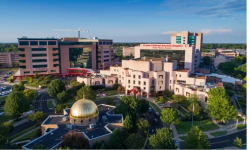
The Proton Center and the Radiation Oncology Department are located on the lower levels of the Chili’s Care Center (CCC) and Kay Research and Care Center (KRCC).
Unlike conventional radiation therapy using an X-ray beam, proton therapy uses protons as the beam source. This lets doctors aim high-dose radiation at cancer cells and spare healthy cells. That means proton therapy may be ideal for treating children whose brains and bodies are still growing.
Protons harm less tissue on the way to the tumor. The protons hold onto their energy and mostly deliver radiation inside the tumor. That means they do not pass beyond the tumor and harm healthy tissue on the other side. Depending on where the tumor is, proton therapy sends much less radiation to healthy tissue.
This explains why proton therapy may cause fewer late effects than other radiation treatments. Late effects are health conditions that appear months or years after treatment is over. Avoiding late effects of treatment is especially important for children who are treated while their brain and body are rapidly developing.